Showing posts with label review copy. Show all posts

Three 2012 Picture Books

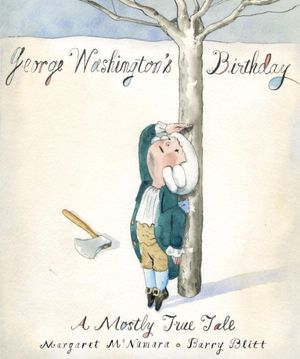
George Washington's Birthday: A Mostly True Tale. Margaret McNamara. Illustrated by Barry Blitt. 2012. Random House. 40 pages.

When George Washington went to sleep Friday night, he was six years old. When he woke up on Saturday, he was seven. It's my birthday, he thought. Happy birthday to me. 

The premise of this fictional picture book starring a young George Washington is simple. It imagines one day in his childhood. It asks two questions: What was George Washington like as a young boy--say, a seven-year-old boy--and what was his home life like, how would his birthday have been remembered?

In this picture book, George Washington gets more than a little grumpy when his family seems to forget his birthday. If only there was a way for everyone to always, always remember it.

Read George Washington's Birthday
  • If you like fictional picture books based on real people (though so much of this one is fictional)
  • If you like historical picture books
  • If you are teaching George Washington in your classroom and other books are too wordy.
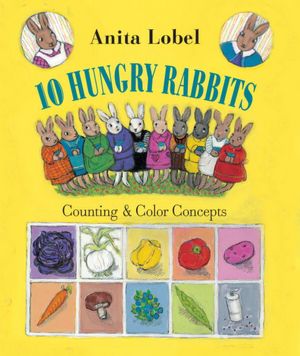
10 Hungry Rabbits. Counting & Color Concepts. Anita Lobel. 2012. Random House. 24 pages.

Mama Rabbit was sad. "I have nothing to put in my soup pot for dinner," she sighed. "But. Mama," whined ten little rabbits. "We are very, very, VERY HUNGRY!" "There is the garden," said Papa Rabbit. "You are sure to find good things for Mama's soup pot there." Ten little rabbits agreed, and off they hopped.

This concept book presents colors (purple, white, yellow, red, pink, orange, brown, blue, green, and black) and numbers (one through ten). The "story" in this one is that a family of rabbits is foraging in the garden looking for things to add to the family's soup pot. Each rabbit is successful, though some more successful than others. (I'm not sure I'd personally want to add blueberries to a soup, especially if the soup had cabbage.)

Read 10 Hungry Rabbits
  • If you are looking for a counting concept book to share with young ones
  • If you are looking for a color concept book to share with young ones
  • If you want to encourage a love of vegetables
  • If you like reading bunny stories
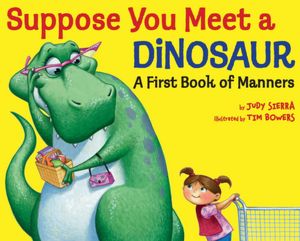
Suppose You Meet a Dinosaur: A First Book of Manners. Judy Sierra. Illustrated by Tim Bowers. 2012. Random House. 40 pages

You're shopping at the grocery store.
Surprise!
You see a dinosaur.
This doesn't happen every day.
So, what are you supposed to say?


Hello. I'm pleased to meet you.


Imagine that the dinosaur
Is standing by a bathroom door.
You have to pee! She's in your way.
Quick! What's the proper thing to say?


Excuse me.


Commotion in the produce aisle!
The dinosaur upsets a pile
Of apples, and they roll away.
If you pick them up, what will she say?


Thank you.

This book surprised me. It really, really surprised me. Why? Well, I'm not a big fan of dinosaur books. In fact, I typically avoid reading them completely because I just don't want to bother reading them, and if I read them, I feel like I should say something about them. And also because I'm not a huge fan of Judy Sierra's rhyming. At least I'm usually not. So I liked this one. I really liked it. I'm not saying I love, love, love it or anything. I'm not saying that I could gush about it for hours or anything. But. I liked the narrative format. I liked how it was all pretend: suppose this, suppose that. I liked how it was addressed straight to the reader: what would you do, what would you say, etc. I liked how sometimes readers were asked what they should say, and sometimes asked what the dinosaur should say. It was a playful concept book.

Read Suppose You Meet A Dinosaur
  • If you're a fan of dinosaur books
  • If you're looking for concept books that teach manners
  • If you're a fan of Judy Sierra
  • If you like silly, imaginative stories

© 2012 Becky Laney of Becky's Book Reviews
Jane Austen Made Me Do It

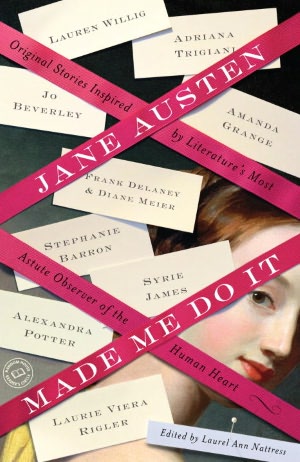
Jane Austen Made Me Do It. Edited By Laurel Ann Nattress. 2011. Random House. 464 pages. Featuring stories by Lauren Willig • Adriana Trigiani • Jo Beverley • Alexandra Potter • Laurie Viera Rigler • Frank Delaney & Diane Meier • Syrie James • Stephanie Barron • Amanda Grange • Pamela Aidan • Elizabeth Aston • Carrie Bebris • Diana Birchall • Monica Fairview • Janet Mullany • Jane Odiwe • Beth Pattillo • Myretta Robens • Jane Rubino and Caitlen Rubino-Bradway • Maya Slater • Margaret C. Sullivan • and Brenna Aubrey, the winner of a story contest hosted by the Republic of Pemberley

Jane Austen Made Me Do It is a great, great short story collection!!! While I didn't LOVE each and every story in this one--some I merely liked--there were so many good stories in it, that it is definitely worth reading!!! This isn't one of those short story collections with one or two or even three good stories worth your time. No, this collection has MANY good stories to offer Austen fans. Granted, your favorites may not be my favorites, and my favorites may nt be your favorites. There's just enough diversity in these stories to please everyone.

The collection begins strong with Syrie James' Jane Austen's Nightmare. In this story, Jane awakes from a nightmare. She shares it, of course, with her dearest companion. In her dream almost all of her characters were confronting her, challenging her. None of her characters were happy with how they'd been presented. Of course, not all of her characters were complaining--Jane, Elizabeth, Darcy, and Bingley have more than enough reason to thank their creator. But for readers who dare to question the text, this story is playful and fun. Was Jane Austen 'too mean' to some of her characters? Should some of her bad boys have been reformed? Were some of her heroines too good to be true? Did any of her characters deserve different fates?

"Waiting," "Heard of You," and "Love Letter" relate to Persuasion, my favorite Austen novel. "Waiting" by Jane Odiwe stars Anne and Captain Wentworth. "Heard of You" by Margaret C. Sullivan imagines the love story of Wentworth's sister, Sophy, and Admiral Croft. And "Love Letter" by Brenna Aubrey uses a page ripped from a novel--the novel--to reunite a couple after years apart.

"Nothing Less Than Fairy-land"  by Monica Fairview imagines just how tricky a happy marriage might prove to be ffor Emma and Mr. Knightley. How her father won't be the easiest person in the world to live with, and how their happily ever after will have to be fought for day by day, not that it's not possible to love someone, to stay in love with someone. But that it takes work, it isn't effortless by any stretch of the imagination.

"Jane Austen and the Mistletoe Kiss" by Jo Beverley is a nice addition to this collection because for once it is the mother (the widow with grown daughters) who wins the guy...

"Mr. Bennet Meets His Match" by Amanda Grange imagines the courtship of Mr. and Mrs. Bennet.

"Jane Austen's Cat" by Diana Birchall is a quirky story, it's true, it may not be for everyone, but it's fun for cat lovers.

But my favorite story, my FAVORITE, FAVORITE, FAVORITE story from the collection is "Intolerable Stupidity" by Laurie Viera Rigler. This story is amazing, witty, clever, joyful. It is a true must read!!! Every page of has sparkle, has wit. It just begs to be read aloud so the giggles can be shared. In this story, the authors who have dared to touch the Creator's works have been put on trial. For any author who has dared to adapt, retell, modify, etc. This includes those who have filmed adaptations--the wet Mr. Darcy scene, for example. This includes those who have dared to add vampires, zombies, mummies, and sea monsters. To those who have dared enter the bedroom... This is very much a trial--and it features many characters from the novels! Including Mr. and Mrs. Darcy, of course. And Lady Catherine!!! Anyway, it's a true delight!!!! I just LOVED it.

© 2012 Becky Laney of Becky's Book Reviews

Crow (MG/YA)

Crow. Barbara Wright. 2012. Random House. 304 pages.

The buzzard knew. He gave the first warning. I was playing in the backyard while my grandmother stirred the iron wash pot over the fire. She had gray hair and a bent back. Standing, she looked like the left-hand side of a Y. If she'd been able to straighten her back, she would have been taller than me, but since she couldn't, we were the same height. I called her Boo Nanny. She joked that I should call her Bent Granny. 

Crow by Barbara Wright is a book that I could gush on and on and on about. Because it is just that wonderful. Because the characterization was amazing. Because the narrative voice was so strong. Because the story was incredibly compelling. Because the drama was so intense. Because it is a story that NEEDS to be told. Because it is so heartbreaking. I mean this book just keeps tugging and tugging and tugging at your heart.

Set in 1898 in Wilmington, North Carolina, Crow is a dramatic story of the events leading up to Wilmington Massacre of 1898. (Had you heard of it before? I sure hadn't.) It is narrated by an eleven year old boy, Moses Thomas. He is close to his family--especially his grandmother, Boo Nanny, and his father, whom he admires. (His father is one of four black aldermen in Wilmington; there are ten aldermen all together. His father also works for the Wilmington Daily Record, "the only Negro daily in the South.") Family dynamics feature prominently in this novel. The Thomas family is not presented as perfect--far from it--the tensions between family members, especially between the father and Boo Nanny (his mother-in-law) are fierce. But never for a second, did I doubt how strong and resilient and loving this family could be. Their kindness for one another, their concern for one another, their joy of being together, well, it was something I loved seeing.

So Crow is a novel about race relations, racial tensions between the black and white communities in Wilmington, North Carolina. It is about MORE than that. It is a novel with depth, substance. It is a meaning-of-life kind of novel, I thought. But the subject matter can't be ignored.

One of the big issues of the book is how the editor of the Wilmington Daily Record wrote an editorial in response to something he'd read. A woman who was calling for action, encouraging men to lynch those blacks who dared (or allegedly dared) to be "too forward" with white women. He dared to look at the other side of the issue. What about those white men who forced themselves on black women? What about all the slave owners who became involved with their slaves--with or without consent. What about all the white men that fathered children with their slaves? If interracial involvement was wrong, immoral, dangerous, something to be avoided at any and all costs, shouldn't it work both ways? Much more about this can be found on this website, 1898 Wilmington Debunking the Myths. His editorial made him no friends--only enemies on both sides. For his editorial made the white community angry and aggressive and ready to attack. And the black community did not want to fight this battle--did not want to be the target.

Of course, that isn't the only factor in the novel. It isn't that simple. It's also about Republicans and Democrats. The constitution. The right to vote in elections. It's about justice and equality. Or should that be injustice and inequality? Crow is set during an election year, and politics is VERY important.

Crow isn't just an issue book though. I know it may sound like an "important" book, an "issue" book. But it's also a good book if you're looking for a compelling story with a strong narrative. If you enjoy coming of age stories. If you can appreciate good writing, good characterization, then you'll find something special in Crow.

"There is not one Constitution for white folks and a separate one for black folks. There is one Constitution for all Americans, no matter what the color of their skin, and it promises us the right to vote. This is what we are guaranteed, and we will settle for nothing less." (220) 

Read Crow
  • If you're looking for a great book; strong narrative voice, amazing characterization, memorable characters, great storytelling, great writing.
  • If you're looking for a book set in the American South from an African-American perspective
  • If you're looking for historical fiction set during this time period, 1890s
  • If you're looking for a book with heart and soul, depth and substance
  • If you're looking for historical fiction based on real events (though the Thomas family is fictional, a handful of characters were based on real people, Wright even used their own words.)

© 2012 Becky Laney of Becky's Book Reviews
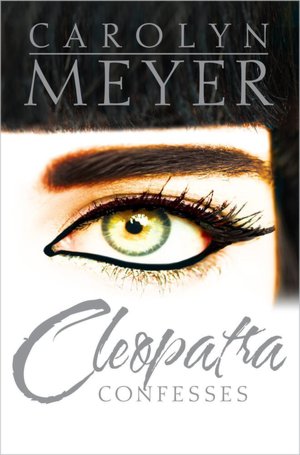
Cleopatra Confesses (YA)

Cleopatra Confesses. Carolyn Meyer. 2011. Simon & Schuster. 304 pages.

From the prologue: My enemy stands at the gates of my city, Alexandria in Egypt. 

From chapter one: I gaze out at the sea and remember a summer day in the reign of my father, King Ptolemy XII. In this memory I am ten years old. It is the season of the Inundation, the time of year when the Nile overflows its banks, flooding the fields and renewing them for planting. 

While Cleopatra Confesses wouldn't be my absolute favorite Carolyn Meyer novel, I can easily say that it was a good book. I found it compelling. True, most readers will know the ultimate fate of Cleopatra. But still, this historical novel for teens focuses on Cleopatra's journey to that event. The novel is divided into sections. We see her as a young child who loves and adores her father. We see her as a young teen who distrusts her older sisters who proclaim themselves queens when their father enters exile. We see her fear for her life, but meet fear with determination, with strength not weakness. We see her happy reunion with her father, we see her share some of the glory with her father, with her brother, as she does become Queen. We see her as she becomes a mature woman who desires love and passion in addition to power. Julius Caesar gets a little attention--a chapter or two. But if you're expecting this to be a love story--though a tragic, slightly unusual love story--between Mark Antony and Cleopatra, you'll be disappointed. Just an epilogue brings readers up to date. I actually was pleased with this. Because the other story has been told again and again and again. But this story that focuses on her early years, on the rivalry between her and her sisters, on her unhappy marriages to her much, much younger brothers, on her early years as Queen, that is the story that is most worth telling. Especially for this audience.

Read Cleopatra Confesses
  • If you're a fan of Carolyn Meyer
  • If you're a fan of historical fiction, particularly historical fiction set in Egypt
  • If you're interested in the Roman Empire
  • If you're a fan of Shakespeare (Julius Caesar and Antony and Cleopatra)
  • If you're interested in politics and power struggles--particularly within families!


© 2012 Becky Laney of Becky's Book Reviews
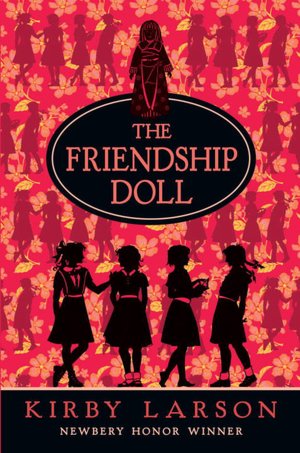
The Friendship Doll (MG)

The Friendship Doll. Kirby Larson. 2011. Random House. 208 pages.

The old doll-maker Tatsuhiko poured boiling water into the teapot with trembling hands and inhaled deeply. It was the last of his tea. He portioned out his breakfast rice and took a seat on a tatami mat. One of the blessings of growing old was that it did not take much to make his stomach content. And this morning his heart was so full that food seemed trivial.

One Japanese doll, Miss Kanagawa, sent in friendship in 1927, finds herself 'awakened' to the joys and sorrows of humanity in Kirby Larson's The Friendship Doll. Miss Kanagawa will be seen by many, many people in her travels. Especially at the beginning. When she's on display, when she's on tour, with the other friendship dolls. But can a doll touch others--touch human lives--if she herself can't be touched or played with?

The Friendship Doll is historical fiction with a touch of fantasy. (Readers will have to believe that a doll is capable of thinking and loving, etc.) The book is a series of stories, the main connection between the stories being the doll. Each story is set in its own time period. The first is set in 1927; the second in 1933; the third in 1937; the fourth covers a handful of years--1939 to 1941. (There is an epilogue that brings it closer to the present.)

For much of the novel Miss Kanagawa acts as a conscience for a handful of heroines. She does this without saying a word, of course. But Miss Kanagawa is more than just a scolding sort of doll. She becomes more 'alive' with each experience. She has always been observant, but she becomes wiser and more compassionate with each adventure. (More human, less doll-like).

Did I like this one? Yes!!! I definitely liked this one! It was interesting to see the different characters. I think I liked the 1933 and 1937 stories best of all. But I enjoyed all of them.

Read The Friendship Doll
  • If you like stories about dolls. Like Hitty, Her First Hundred Years. Like Miss Hickory. Like The Miraculous Journey of Edward Tulane. Like The Velveteen Rabbit.
  • If you like historical fiction set in the 1920s, 1930s, 1940s.
© 2012 Becky Laney of Becky's Book Reviews

Divergent (YA)

Divergent. Veronica Roth. 2011. May 2011. HarperCollins. 496 pages.

There is one mirror in my house. Our faction allows me to stand in front of it on the second day of every third month, the day my mother cuts my hair. It is behind a sliding panel in the hallway upstairs.


Beatrice Prior, our sixteen-year-old narrator, is about to make the most important decision of her life. For two big days are coming: the day of the aptitude test and the Choosing Ceremony. Soon Beatrice will have to decide which faction she'll belong to for the rest of her life. If she chooses outside her parents' faction, she may never see them again. For ties to one's faction must come first. The five factions are as follows: Abnegation (the selfless), Amity (the peaceful), Candor (the honest), Dauntless (the brave), and Erudite (the intelligent). Beatrice has been raised Abnegation, but it's always felt like a wrong fit. Selflessness does not come easy for her. She has spent the first sixteen years of her life practically invisible--blending into the background. But Beatrice has secretly been watching her Dauntless classmates. Dare she admit it aloud? She's thinking of choosing the most rebel faction of all!

But not all initiates make it into the Dauntless faction. Only the bravest. Only the strongest. Only the best. Readers follow Tris (Beatrice) on her new journey. We meet fellow initiates--those born Dauntless, and those transferring from other factions. We follow their training through three stages. They will be challenged physically, mentally, and emotionally. We become familiar with their two trainers--Eric and Four. We see the faction's strengths and weaknesses. As does Tris. On the one hand, Tris realizes she is fierce. She can be strong, determined, brave. She is learning to face her fears, learning to face life. But she's also realizing that compassion and love are part of courage. That selflessness has prepared her for her new life. On the other hand, she sees how heartless, how cruel some are. Yes, the Dauntless have their flaws.

Divergent is an action-packed dystopia. It's exciting. It's compelling. It's impossible to put down. The futuristic Chicago setting has been well-crafted. While only two factions are explored in this first novel in the trilogy, the glimpses we get of this world are fascinating. I loved the setting, the world-building. I loved the characters. Tris is such a great heroine. And Four. Well, I don't want to spoil it. But he's definitely a large part of why I loved this one! I would definitely recommend this one. I think I loved it even more than The Hunger Games trilogy.

© 2011 Becky Laney of Becky's Book Reviews